Commercial Water Damage Restoration in Boulder, CO
A burst pipe, sprinkler discharge, or roof drain failure can shut down a Boulder business for days. Every hour the floors stay wet, inventory is at risk, tenants are displaced, and revenue stops. We respond to commercial water damage 24 hours a day with emergency water removal crews at your property within the hour. There is no extra charge for nights, weekends, or holidays. Call (303) 479-3055 for a free commercial estimate.
Why Commercial Properties Face Bigger Risks
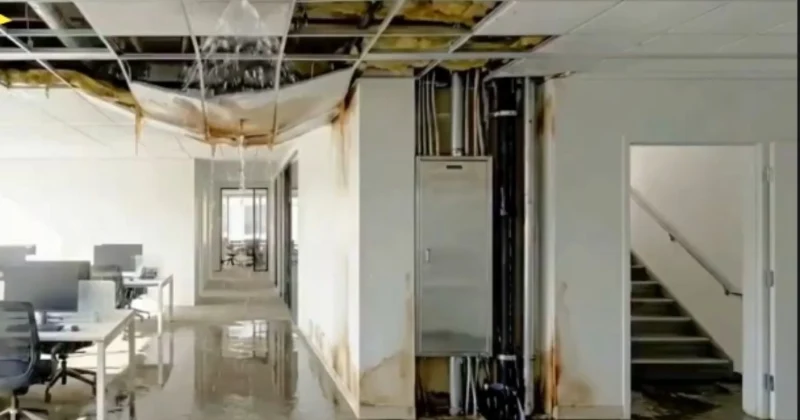
Residential water damage involves one household. Commercial water damage involves employees, customers, tenants, inventory, equipment, lease obligations, and sometimes multiple business operations in one building. The same wet drywall that is a week-long inconvenience in a home can be a business-closing event in a retail space or office suite.
A water event in a multi-tenant building can trigger lease disputes, business interruption claims, and lost revenue that compounds every day the building is not fully operational.
Commercial buildings also have different construction. Drop ceilings, raised access floors, concrete subfloors, HVAC systems that push moisture across entire floor plates, and dense insulation in walls that holds water long after visible puddles are gone. Getting a commercial building dry takes equipment and experience matched to those conditions.
Common Water Damage Calls for Boulder Businesses
Sprinkler System Discharge
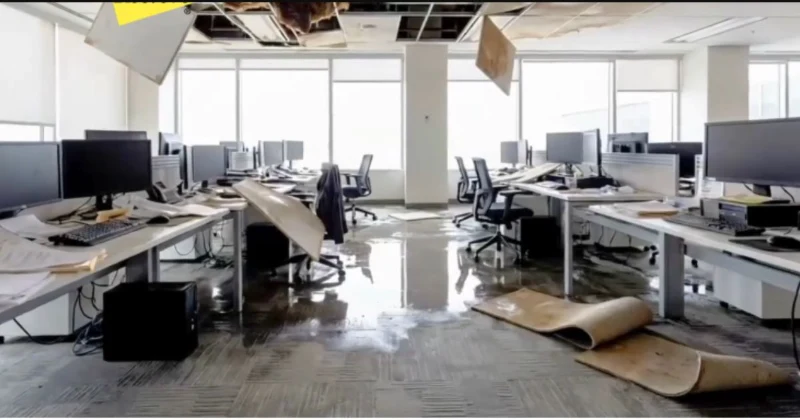
Accidental sprinkler activation, whether from a head bumped during a renovation, a head triggered by heat, or a system fault, can flood an entire floor of a Boulder office building in minutes. Sprinkler systems deliver water at high volume, often with no one in the building to catch it early. By the time anyone arrives, the damage extends through drop ceilings, across concrete subfloors, and into adjacent suites. We extract standing water, dry the entire affected floor plate, and document every area for insurance.
Roof Drainage Failure
Boulder’s flat-roof commercial buildings and warehouses are especially vulnerable. A blocked roof drain or failed membrane during a heavy storm backs water up onto the roof and eventually into the building through any penetration point. The 2013 flood exposed exactly this vulnerability across Boulder’s lower Pearl Street and Basemar properties. We respond to roof drainage failures, extract water from affected spaces, and dry the full affected footprint.
Plumbing Failures in Multi-Tenant Buildings
A broken water main connection, a failed supply line, or a clogged drain overflowing on the second floor sends water down into the first-floor tenant’s space. These events create disputes between tenants, landlords, and their respective insurers. We document the damage in each affected unit separately, provide dated photos and moisture readings per unit, and produce a written scope that each party’s adjuster can use independently.
HVAC Condensate Overflow
Rooftop units, air handlers, and condensate drain lines are a frequent source of water damage in Boulder office buildings. A clogged condensate drain line overflows inside a ceiling plenum, saturating the insulation above a drop ceiling. The water shows up weeks later as a stained ceiling tile, by which point structural materials above the tile are significantly wet. A trained restoration technician can trace the damage to its source, dry all affected materials including ceiling cavities, and document the full extent.
Retail Space Flooding
Retail spaces on Pearl Street Mall and in the Twenty Ninth Street corridor have concrete subfloors with floating hardwood, polished concrete, or large-format tile on top. Water infiltration from a neighboring space or from a slab leak migrates under those floor coverings invisibly. We use moisture meters to map the full extent of migration, extract visible water, and set drying equipment under and around affected areas to prevent subfloor damage.
What Happens If You Delay Restoration
Every hour counts after water enters a commercial building. Within the first few hours, drywall begins to absorb moisture and swell. Within 24 to 48 hours, conditions can develop that support mold growth behind walls and inside ceiling cavities. After 72 hours, structural materials may need replacement instead of drying, and based on industry experience, total restoration costs tend to rise significantly when response is delayed. Tenants may break leases. A health department could shut down food service operations. Business interruption insurance may not cover losses tied to a delayed response, and the gap between actual repair cost and covered cost grows with every passing day.
Waiting to see if it dries on its own risks further structural damage. Call (303) 479-3055 right away. Our commercial crew arrives within the hour, any time of day, with no extra charge for off-hours calls. Every commercial job begins with a detailed, itemized estimate before restoration starts.
Our Response Process
Step 1: Arrival Within 60 Minutes
We answer commercial calls around the clock and dispatch immediately. Crew is on-site within 60 minutes. The first action is to understand the source. Is water still flowing? If yes, the priority is to stop it. We coordinate with building maintenance or the plumber on-site to confirm the source is isolated before beginning extraction.
Step 2: Written Estimate Before Work Begins
Before restoration begins, you receive a detailed, itemized estimate covering the complete scope of work. No hidden costs. If the scope expands during restoration, we obtain your written approval before performing any additional work. This keeps you protected and provides your property manager or insurer with a documented record from day one.
Step 3: Commercial-Scale Extraction
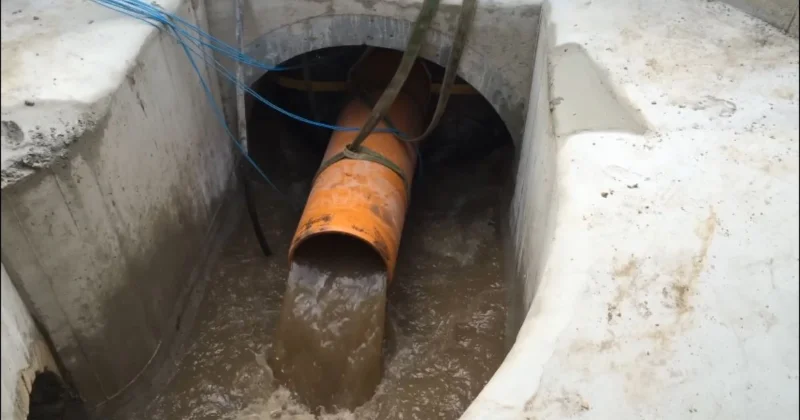
We bring truck-mounted and portable extraction units capable of handling large floor areas. For high-rise or restricted-access spaces, we bring portable units that work in stairwells, elevators, and spaces where truck access is not available. Extraction is thorough. We move furniture and equipment, extract from under raised floors when accessible, and work from the perimeter toward the center to prevent spreading contamination.
Step 4: Moisture Mapping with Thermal Imaging
After extraction we map the full moisture extent using pin and pinless moisture meters and thermal imaging for a complete water damage inspection. In commercial spaces this mapping is critical. Water migrates under tile, through shared walls, into the ceiling cavities of adjacent suites, and into raised access floor systems. We document every reading, every location, every surface tested. This becomes the baseline against which daily drying progress is measured.
Step 5: Drying Equipment Placement
We place commercial-grade dehumidifiers and high-velocity air movers based on the moisture map. Equipment placement in a commercial space accounts for HVAC zoning, ceiling height, air circulation paths, and the need to minimize obstruction to any remaining business operations. Where possible, we work around your operation to let you stay open during drying. Our full water mitigation and drying process is built around IICRC S500 standards for commercial structural drying.
Step 6: Daily Drying Monitoring with Dated Photos
We visit the site daily, record moisture readings at every documented point, and compare them to baseline. Your property manager, ownership group, or insurer receives daily updates with dated, time-stamped photos showing exactly where the drying process stands. We reposition and adjust equipment as moisture levels drop to speed up the final drying stages. The daily drying log, with readings per location and photo documentation, becomes part of your final package.
Step 7: Written Documentation Package
At the end of the job you receive a complete documentation package. This includes dated photos of the damage at discovery, daily moisture readings by location and surface, the final dry-out readings verifying all materials have returned to acceptable moisture levels, and a complete written scope of work. This documentation is what a commercial property insurer typically needs to process a claim efficiently.
Preparing Your Property Before the Crew Arrives
If water is actively flowing, shut off the source if you can do so safely. Move electronics, documents, and inventory above water level or to a dry area. Open doors between wet rooms to improve airflow, but do not turn on the HVAC system, which can spread contamination through the ductwork. Take photos of the damage with your phone for your own records. Make sure there is a clear route from the building entrance to the damaged area so the crew can move equipment in without delay. Shop vacuums and portable fans are not effective on commercial-scale water events. Professional extraction equipment handles the volume faster and prevents secondary damage.
Working with Property Managers and Building Owners
We work directly with property managers, facilities directors, and building ownership groups, not just the tenant who called first. Commercial water damage often involves multiple parties: the building owner, one or more tenants, a commercial property insurer, and sometimes a construction contractor who needs to understand the full scope before beginning repairs.
We can provide separate documentation for each tenant’s space within a multi-tenant event, produce a full building-wide scope, and communicate directly with your property management company’s preferred contacts. On multi-floor events, we can stage equipment and crew on multiple levels simultaneously to reduce overall drying time. You receive dated photos, daily moisture readings, and a full written scope for your adjuster. Every insurance policy is different, so we do not make promises about what your policy will cover. Review your declarations page or speak with your agent about what your plan covers.
Boulder Commercial Properties We Serve
- Office buildings and professional suites on 28th Street, Arapahoe, and Canyon corridors
- Retail spaces on Pearl Street Mall and Twenty Ninth Street
- Restaurant and food service operations downtown and in Boulder Junction
- Warehouse and light industrial in Gunbarrel and East Boulder
- Multi-tenant apartment buildings and mixed-use properties throughout Boulder
- University-area student housing near CU Boulder
- Medical and dental office suites
- Hospitality properties and boutique hotels
Commercial Water Damage Questions
Can we stay open during drying?
Often yes, depending on the type of business and the extent of damage. Drying equipment is noisy, so it may not be compatible with quiet office work, but warehouse, light industrial, and many retail operations can continue while equipment runs. We discuss how to minimize interference with your operation from the start.
How long does commercial drying take?
IICRC The EPA and IICRC S500 standard both target drying wet materials within 24 to 48 hours of a water event, because mold can begin growing on damp porous surfaces within that window under the right conditions. In practice, a commercial drying job ranges from 3 to 5 days for a contained event affecting one suite, to 7 to 10 days for a large floor plate with structural materials involved. We track progress daily and provide a straightforward timeline based on measured data.
Who do you coordinate with on a commercial claim?
We work with the property manager or building owner as the primary contact and can speak directly with your insurance adjuster to explain scope and documentation. We do not negotiate your claim or promise any specific outcome. We provide the documentation the adjuster needs to do their job accurately. Every policy is different, so speak with your agent or review your declarations page for coverage questions.
Do you provide a written estimate before starting work?
Yes. Every commercial job begins with a detailed, itemized estimate before restoration starts. You know the full scope and cost upfront. If the scope expands during restoration, we obtain your written approval before performing any additional work. No surprises on your invoice.
Do you offer free estimates for commercial water damage?
Yes. We offer free on-site assessments for any commercial property in the Boulder area. Our IICRC-certified team evaluates the complete scope of damage, documents every affected area, and provides a written scope before restoration begins. Call (303) 479-3055 to book your assessment.
24/7 Commercial Response. Call Now
Commercial water damage does not wait for business hours. Neither do we. Call (303) 479-3055 any time and our commercial team deploys immediately. IICRC-certified technicians at your location within the hour across Boulder. Free commercial estimate. No extra charge for off-hours calls.
Boulder CO Water Damage Restoration
Phone: (303) 479-3055
Email: info@bouldercowaterdamage.com